- WEB DESK
- November 12, 2026
Nestle Pakistan’s sustainability journey recognised at SDC, SIE
-

- WEB DESK
- November 12, 2026
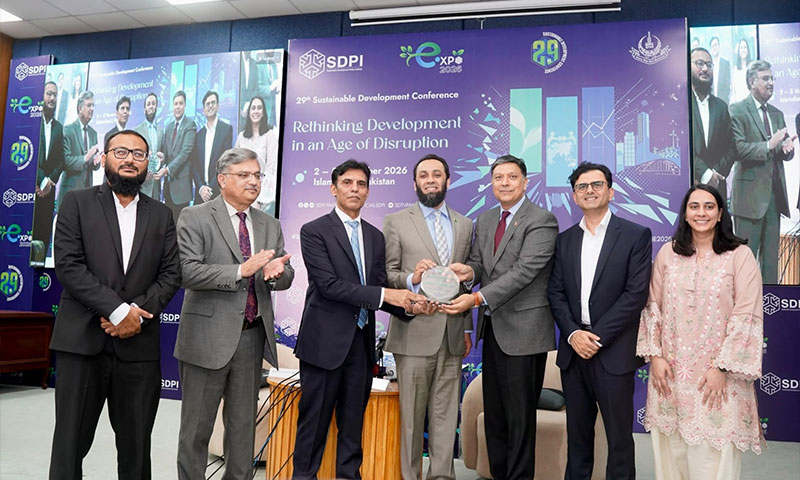
Practical action across operations, farms and communities, bringing together sustainability commitments to life were in focus at the 29th Sustainable Development Conference (SDC) and Sustainability Investment Expo (SIE) in Islamabad, where Nestle Pakistan showcased its journey across climate action, regenerative agriculture and circularity.
The company’s efforts were recognised with two accolades at the conference: the Sustainability Award in the Circular Economy & Resource Efficiency category and the Best Pavilion Presentation Award.
The recognition came alongside Nestle Pakistan’s participation in conversations around the future of sustainable food systems, including a high-level plenary on “Transforming Pakistan’s Agriculture and Food Systems in an Age of Disruption: AI for Regenerative and Climate-Smart Agriculture.”
The conference and expo also provided an opportunity to engage policymakers and other stakeholders around some of the practical interventions already underway. Rana Tanveer Hussain, Federal Minister for National Food Security & Research, and Shezra Mansab, Minister of State for Climate Change, were among the senior government representatives who visited Nestle Pakistan’s exhibition, which brought together initiatives spanning regenerative agriculture, climate action, water stewardship and circularity.
Nestle Pakistan also co-hosted a high-level plenary titled “Transforming Pakistan’s Agriculture and Food Systems in an Age of Disruption: AI for Regenerative and Climate-Smart Agriculture” at the conference.
Opening the discussion on Nestle Pakistan’s efforts and initiatives, Head of Technical Faisal Nadeem shared: “With cultivable land under increasing pressure and soil health declining, the need to transition towards regenerative agriculture has never been greater. The encouraging part is that soil health can be restored. At Nestle, we are working with farmers and partners to scale regenerative practices that improve soil health, improve water efficiency, and strengthen resilience to climate pressures.”
Sharing the humanitarian perspective, World Food Programme (WFP) Pakistan’s Country Director Anita Hirsch said: “As climate and economic disruptions increase, we need to ensure that food continues to reach the people who need it most. By working with local communities and integrating AI and supply-chain solutions, we can help improve food security while creating more predictable income opportunities.”
Sharing learnings from Nestle’s global experience in advancing regenerative agriculture, Nestle S.A Global Sustainability Delivery Manager Katarzyna Grzybowska said: “At Nestle, we have committed to sourcing 50% of our key ingredients from farmers adopting regenerative agriculture practices by 2030, and we are already about halfway towards this ambition. Regenerative solutions need to be adapted to local realities, with farmer economics at the centre. Scaling this transition also requires the wider food system to come together, share risk across the value chain, and invest for the long term.”
Sustainable Development Policy Institute (SDPI) Executive Director Dr Abid Qaiyum Suleri said: “Pakistan’s agriculture and food systems are increasingly exposed to the challenges of climate change and economic disruptions. Harnessing AI and smart agriculture, alongside stronger public-private partnerships, can help accelerate the transition.”
Highlighting the importance of translating commitments into action, Nestle Pakistan and Afghanistan Head of Corporate Affairs and Sustainability Sheikh Waqar Ahmad also shared: “Building more resilient food systems requires moving from ambition to action. For Nestle, this means working with farmers and creating new partnerships to advance regenerative agriculture across the value chain.”
Lahore University of Management Sciences (Lums) Associate Professor Dr Zaigham Shahzad shared: “By bringing education, research and innovation together, we can contribute to a more resilient agricultural system in Pakistan. Our recently launched certification program with Nestle is a step to accelerate this transition while securing the future of agriculture.”
The two recognitions reflect Nestle Pakistan’s sustainability efforts across its value chain. The company is scaling regenerative agriculture practices across 125 farms, supported by 135 solar systems and 25 biogas plants, alongside water-saving technologies including drip irrigation across 299 acres and smart soil moisture sensors across 722 acres. Advancing its focus on better systems and circularity, Nestle Pakistan’s Clean Gilgit-Baltistan Project has also facilitated the management of over 11,000 tons of plastic and paper packaging waste.
Nestle Pakistan’s efforts are in line with the United Nations Sustainable Development Goals (SDGs), particularly SDG 13 (Climate Action), SDG 2 (Zero Hunger), and SDG 12 (Responsible Consumption and Production).
You May Also Like