- WEB DESK
- November 12, 2026
‘Water must never be weaponised’: PM Shehbaz stresses Indus Water treaty obligations at COP31
-

- WEB DESK
- November 12, 2026
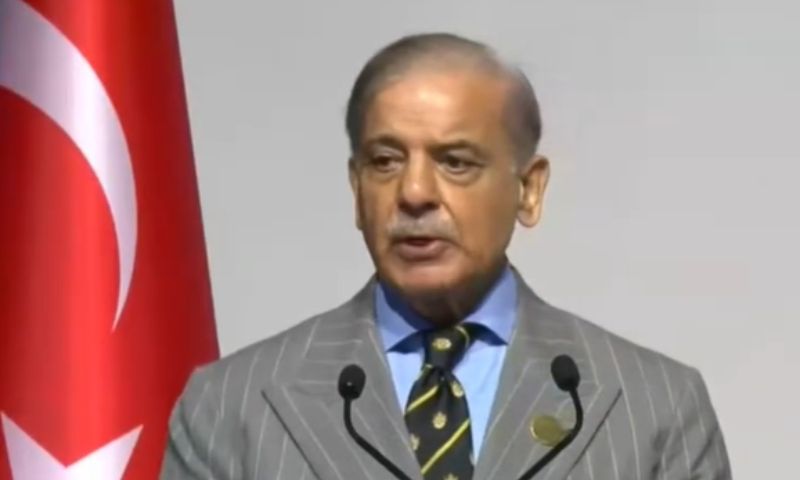
Prime Minister Muhammad Shehbaz Sharif on Thursday warned against using water as a weapon, calling on countries to honour water-sharing agreements and protect downstream populations, as he urged world leaders at the COP31 climate summit in Turkiye to provide grant-based financing to countries facing devastating climate disasters.
Addressing the United Nations climate conference in Antalya, PM Shehbaz said international cooperation was essential to protecting vulnerable populations from the growing consequences of climate change.
“Water must never be weaponised. No nation should be allowed to put the lives and livelihoods of people downstream at risk. Water-sharing agreements must be honoured in letter and spirit,” he said.
Although PM Shehbaz did not name India, his remarks came amid an ongoing dispute over New Delhi’s decision to place the Indus Waters Treaty in abeyance in April 2025. Pakistan has repeatedly opposed the move, warning that any disruption to its share of the Indus river system could threaten agriculture, livelihoods and water security for millions of people.
PM Shehbaz also warned that developing countries, despite contributing relatively little to global emissions, continued to bear a disproportionate share of the damage caused by extreme weather.
“People who have contributed the least to climate change bear its heaviest consequences,” he said.
He called for international climate assistance that would help vulnerable economies rebuild without placing them under additional debt.
“When climate disasters strike, vulnerable countries need timely help and finance that does not deepen their debt,” PM Shehbaz said.
He urged developed countries and international institutions to expand grant-based financing, encourage public-private partnerships and substantially increase funding for climate adaptation and resilience.
PM recalls Pakistan’s devastating floods
Recalling the 2025 floods, PM Shehbaz shared the story of a young Pakistani man whose wedding was only two days away when flash floods swept through his village.
The family home, which had been preparing for a celebration, became a place of mourning, he said.
The prime minister recalled meeting families who had lost their homes, livelihoods and loved ones, saying their suffering reflected the experiences of millions of people across the developing world.
He also referred to the catastrophic floods of 2022, which submerged nearly a third of Pakistan, affected approximately 33 million people and killed more than 1,700.
The disaster caused economic losses exceeding $30 billion and destroyed crops and infrastructure across large areas of the country.
“Four years ago at the United Nations, I warned that what happens in Pakistan will not stay in Pakistan,” PM Shehbaz said.
“Unfortunately, that warning has become a stark reality. The future we feared has become the present we are living.”
He said climate change recognised no national boundaries and required a coordinated international response.
“Climate change knows no borders. No nation can face it alone. Solidarity must mean real action,” he added.
Pakistan highlights solar expansion, emissions targets
Outlining Pakistan’s climate commitments, PM Shehbaz said the country had added more than 20 gigawatts of distributed solar power capacity over the past two years.
He said clean energy sources now accounted for nearly 55 percent of Pakistan’s energy mix, while the government was expanding electric mobility and pursuing a target to reduce projected emissions by approximately 50 per cent by 2035.
The prime minister also highlighted progress on the Chashma-5 nuclear power project, saying it would add 1,200 megawatts of low-emission electricity once operational.
He stressed, however, that domestic efforts could not substitute for an equitable global response, particularly for countries facing repeated disasters and financial constraints.
PM Shehbaz thanked Turkish President Recep Tayyip Erdogan and the people of Turkiye for hosting COP31, and acknowledged Australia’s role in leading the conference negotiations.
He also expressed gratitude to Turkiye for supporting Pakistan during the devastating floods of 2010 and 2022.
Concluding his address, the prime minister urged world leaders to judge the summit by the practical outcomes it delivered.
“At COP31, let our success be measured not by the promises we make here, but by the families we protect, the resources we deliver and the meaningful action we sustain,” he said.
You May Also Like