- Talha Saeed
- November 12, 2026
Nvidia board weighs ousting Jensen Huang as CEO as leadership crisis deepens
-

- Reuters
- November 12, 2026
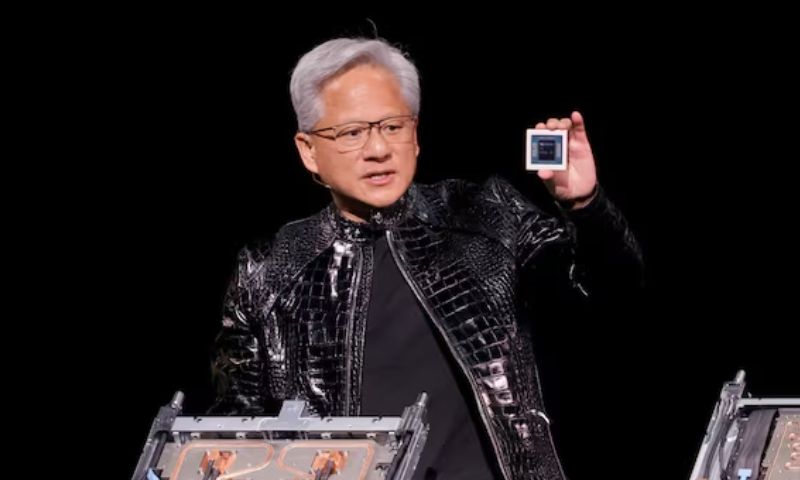
Nvidia’s board is considering removing Jensen Huang as chief executive, the Wall Street Journal reported on Wednesday, in a dramatic turn for the $4 trillion chipmaker as allegations surrounding the longtime leader’s personal relationships and questions over the company’s links to China deepen a crisis that has sent its shares tumbling.
The board meeting marks a dramatic reversal from Sunday, when Nvidia’s directors publicly expressed confidence in Huang and his leadership team. Under the company’s bylaws, Huang can be removed with or without cause through a majority vote of the 11-member board, all but Huang being independent directors.
Nvidia did not immediately respond to a request for comment on the reported board meeting.
The company’s shares fell more than 8% in extended trading after the Wall Street Journal first reported that Nvidia was preparing to fire Huang. If those losses hold, the chipmaker would have shed around $600 billion in market value this week.
The crisis began after US intelligence officials reportedly investigated whether Alice Huang, a businesswoman with whom the Nvidia chief allegedly had an extramarital relationship, had facilitated shipments of the company’s chips to Chinese firms.
The revelations prompted questions on Wall Street about corporate governance and Huang’s personal conduct, while Nvidia’s board launched an internal investigation and hired outside legal counsel. US lawmakers have also begun pushing for tighter restrictions on chip exports to China.
“The market is starting to price Nvidia without its founder as the likely outcome, not a tail risk,” said Armina Rosenberg, portfolio manager and co-founder of Minotaur Capital, which holds Nvidia shares.
“Losing Jensen would be a real blow,” she added.
No obvious successor
Huang’s potential departure would leave a significant leadership vacuum at the roughly $4 trillion chipmaker, which he co-founded more than three decades ago and transformed into the world’s dominant supplier of artificial intelligence processors.
The 63-year-old executive owns around 3.6% of Nvidia’s shares and has no obvious successor. His dozens of direct reports also reflect the centralised leadership structure he has maintained throughout the company’s expansion.
Bloomberg reported on Wednesday that Nvidia’s board had been working with an outside firm to identify potential replacements for Huang, citing a person familiar with the matter.
Rosenberg said Chief Financial Officer Colette Kress, who has held the position for more than a decade, would be a natural choice as an interim chief executive. However, she said the bigger question was who would oversee the company’s technology roadmap in the longer term.
Prediction market Polymarket showed an 88% probability that Huang would resign or be removed by the end of the year. Among potential successors, the odds favoured Ian Buck, who oversees Nvidia’s data centre business.
The leadership uncertainty comes just days before Nvidia is scheduled to announce its quarterly financial results on November 17, when investors will also be looking for guidance on the company’s outlook.
The leadership crisis deepened further on Wednesday after The New York Times reported that Huang had also had an extramarital relationship with Kimberly Powell, Nvidia’s vice president of healthcare, who reported to him.
The newspaper cited five people who had worked at the company.
Asked about his relationship with Powell in a telephone conversation on Wednesday, Huang told the newspaper: “I don’t think you should be talking to me directly.” He then hung up, according to the report.
Nvidia and Powell did not immediately respond to requests for comment. Reuters could not independently verify the report.
Market fallout
The prospect of Huang’s departure sent shockwaves through technology stocks, with US stock futures declining following the reports.
Nasdaq futures fell around 1%, while shares of chipmaker Micron declined nearly 2% and data centre operator CoreWeave dropped 6% in after-hours trading.
By contrast, rival chipmakers Advanced Micro Devices and Broadcom gained 4% and 3%, respectively. In Asian trading, Samsung Electronics rose around 1%, while SK Hynix slipped nearly 1%.
Investors and analysts said demand for Nvidia’s processors was unlikely to weaken immediately. However, concerns were emerging about the wider network of companies backed by Nvidia, particularly businesses building data centres that rely on its chips.
“They are financing their customers. In these types of booms or bubbles, sometimes all it takes is a slowdown to shift it into the bust phase,” said Nick Ferres, chief investment officer at Vantage Point Asset Management in Singapore.
Investigation widens
In a memo to employees on Sunday, Huang acknowledged being unfaithful to his wife and said he took “full responsibility”, without providing details about the relationship.
US President Donald Trump said he had not discussed the allegations with Huang but expressed support for the Nvidia chief, who has maintained close ties with the president.
Huang could also face a congressional subpoena if he does not respond to a request to provide a closed-door briefing to lawmakers about the allegations concerning his relationship with a woman suspected of working for Chinese intelligence.
Separately, Axios reported on Wednesday, citing senior sources, that US Commerce Secretary Howard Lutnick had stalled Trump’s efforts to crack down on companies suspected of diverting Nvidia chips to China.
The report adds another dimension to the controversy, which has raised questions about the intersection of corporate leadership, US national security and technology exports to China.
The White House and a spokesperson for Lutnick did not immediately respond to requests for comment.
You May Also Like