
- WEB DESK
- September 17, 2026
Pakistan’s debt burden deepens as interest bill crosses Rs28.6 trillion
-

- WEB DESK
- September 17, 2026
ISLAMABAD: Pakistan has paid more than Rs28.6 trillion in interest over five years as its public debt more than doubled, highlighting a growing debt-servicing burden that is squeezing the government’s fiscal space, according to Finance Ministry data.
The government paid a total of Rs28,675 billion in interest against public debt of Rs83,285 billion in domestic and external debt during the last five years.
A senior Finance Ministry official, speaking on condition of anonymity, described the situation as a structural debt trap, saying a large interest burden meant that an increasing share of new borrowing was being used to meet existing obligations rather than finance productive investment.
“The doubling of public debt in just five years shows that the fiscal space is shrinking,” the official said.
The official said continued reliance on external financing, including support from the International Monetary Fund, also exposed Pakistan to exchange-rate risks and policy conditionalities.
Without meaningful tax reforms, tighter control over government expenditure and stronger export-led growth, the official warned, the debt-interest cycle could become self-perpetuating and constrain long-term economic stability.
Debt more than doubles
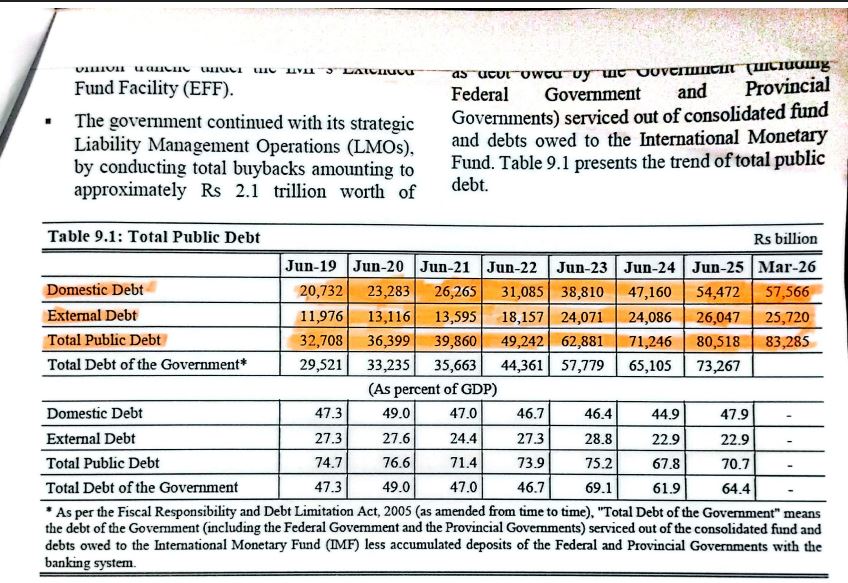
According to the data, Pakistan’s public debt increased from Rs36,399 billion in 2020 to Rs83,285 billion in 2026.
The debt stock stood at Rs39,860 billion in 2021, rose to Rs49,242 billion in 2022, Rs62,881 billion in 2023, Rs71,246 billion in 2024 and Rs80,518 billion in 2025 before reaching Rs83,285 billion in 2026.
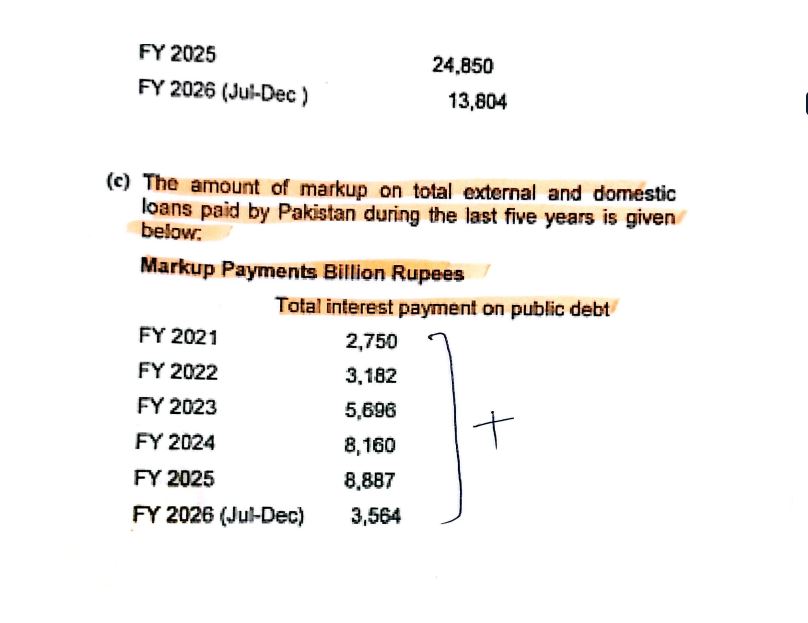
The figures show that the debt burden has continued to rise despite repeated fiscal adjustment programmes and efforts to contain borrowing.
The Finance Ministry’s latest published Debt Bulletin, however, puts total public debt at Rs81.374 trillion at the end of December 2025, comprising Rs55.363 trillion in domestic debt and Rs26.011 trillion in external debt.
The bulletin shows that public debt rose only 1.1 per cent during the first half of FY2025-26, compared with increases of 3.9 per cent and 7.1 per cent in the corresponding periods of the previous two years.
Domestic borrowing dominates
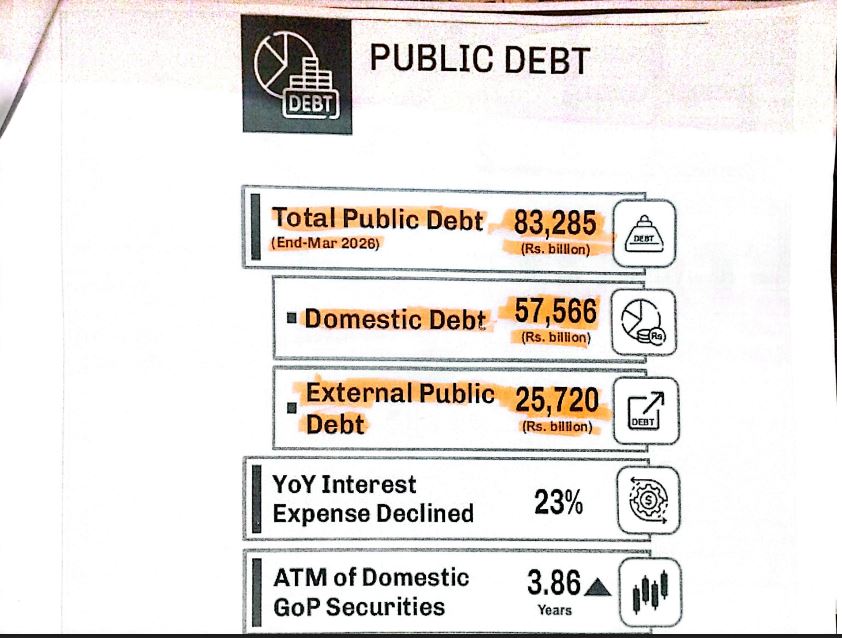
The data available shows domestic debt rising from Rs23,283 billion in 2020 to Rs57,566 billion in 2026, while external debt increased from Rs13,116 billion to Rs25,720 billion over the same period.
The latest official Debt Bulletin similarly shows that domestic borrowing accounts for the bulk of Pakistan’s public debt.
At end-December 2025, domestic debt represented about 68 per cent of the total, while external debt accounted for around 32 per cent.
The Finance Ministry has said the declining share of external debt has reduced Pakistan’s exposure to exchange-rate fluctuations, although external borrowing remains an important source of currency risk.
The government’s current debt-management strategy aims to extend the maturity of domestic debt and reduce vulnerability to interest-rate changes, while its external debt strategy focuses on reducing currency risk and lowering the share of external debt in the overall portfolio.
Interest bill consumes huge share of resources
The scale of the debt-service burden is also evident in the federal budget for FY2026-27.
The government has allocated Rs8.054 trillion for interest payments in the current fiscal year, making debt servicing the largest component of current expenditure. Total current expenditure is budgeted at Rs17.495 trillion.
The government expects net revenue receipts of Rs11.751 trillion in FY2026-27. That means the budgeted interest bill alone is equivalent to about 69 per cent of the federal government’s projected net revenue receipts.
The comparison underscores the pressure debt servicing places on the government’s ability to allocate resources to development, infrastructure and public services.
Fiscal adjustment offers some relief
The debt picture is not entirely negative.
The Finance Ministry’s fiscal policy statement says Pakistan recorded a primary surplus equivalent to 2.4 per cent of GDP in FY2024-25, reflecting efforts to contain non-development expenditure and improve fiscal space.
Tax revenues, however, came in below the budgeted target, highlighting the continuing challenge of raising government income.
The latest Debt Bulletin also reported a federal primary surplus of Rs2.926 trillion during the first half of FY2025-26 and said interest costs declined year-on-year during the period.
The government has also been seeking to improve the structure of its debt rather than relying solely on reducing its overall stock. Its medium-term debt strategy focuses on longer maturities, greater use of fixed-rate instruments and limiting the net issuance of short-term treasury bills.
IMF and external financing
Pakistan’s dependence on external financing remains a key element of its debt-management challenge.
The government has relied on multilateral and bilateral creditors as well as IMF programmes to meet external financing requirements and strengthen its foreign-exchange position.
The Finance Ministry’s debt data shows that external debt remains a significant component of the overall debt stock, although its share has declined in recent years. The government has said reducing this share is part of its strategy to limit exposure to exchange-rate volatility.
For Pakistan, the central challenge is therefore not simply the size of its debt but the cost of servicing it. High interest rates, refinancing requirements and currency movements can increase the burden even when new borrowing is contained.
Need for structural reforms
The Finance Ministry official said Pakistan would need to break its dependence on borrowing through a combination of higher domestic revenue, expenditure reforms and stronger economic growth.
“Without meaningful tax reforms, expenditure rationalisation and export-led growth, this debt-interest cycle risks becoming self-perpetuating,” the official said.
The government has repeatedly sought to widen the tax base, improve revenue collection and reduce non-development expenditure. But the persistence of a large interest bill means a substantial portion of public resources continues to be committed to servicing past borrowing.
“For Pakistan, the challenge is to generate enough revenue and economic growth to reduce reliance on new borrowing while keeping debt-servicing costs under control. Until then, the rising interest bill will continue to limit the fiscal space available for development and other government priorities,” the official said.
You May Also Like



- WEB DESK
- September 17, 2026
Gold prices fall in Pakistan after sharp rise
- WEB DESK
- September 17, 2026