- Reuters
- October 6, 2026
Rubio calls Pakistan key interlocutor in US–Iran talks
-

- Sadia Basharat
- May 23, 2026
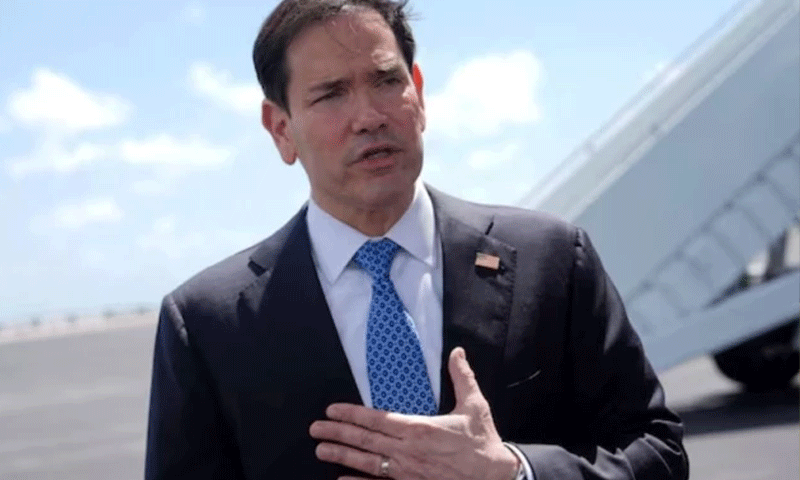
WEB DESK: United States Secretary of State Marco Rubio has confirmed that Pakistan remains the principal mediator in Washington’s high-stakes negotiations with Iran, aiming to bring an end to the ongoing conflict in West Asia.
Speaking to reporters in Sweden following meetings with NATO allies, the top US diplomat praised Islamabad’s diplomatic efforts, describing its mediation role as “admirable” whilst asserting that communication remains open at the highest levels of government.
The diplomatic push comes at a critical juncture. Pakistan’s Interior Minister Mohsin Naqvi recently held intense rounds of talks with Iranian Foreign Minister Abbas Araqchi in Tehran to hammer out a framework for peace, according to The Express Tribune.
Meanwhile, Washington is closely monitoring the movements of Pakistan’s Chief of Defence Forces, Field Marshal Asim Munir, who is scheduled to arrive in Iran to facilitate further breakthrough discussions.
Despite “slight progress” reported in the text of the negotiations, significant obstacles remain. The global economy continues to reel from what the International Energy Agency (IEA) has termed the world’s worst energy shock, triggered by the disruption of vital maritime trade.
The Battle for the Strait of Hormuz
A central sticking point in the negotiations is Iran’s attempt to establish a controversial “tolling system” in the Strait of Hormuz. Tehran, which has effectively closed the strategic channel to most international shipping since the conflict erupted on 28 February, is reportedly trying to persuade Oman to back a plan to charge fees to passing vessels.
The move has drawn fierce condemnation from Washington. Secretary Rubio labelled the proposed tolling system “completely illegal” and a “threat to the world”, warning that accepting such leverage would set a dangerous global precedent.
President Donald Trump has doubled down on the US position, insists the channel must remain a free, open international waterway, and has warned that the US and its partners are actively preparing a “Plan B” contingency to forcefully reopen the strait if diplomatic avenues collapse.
United Arab Emirates presidential advisor Anwar Gargash echoed these anxieties at the Globsec conference in Prague, placing the odds of a peace agreement at “50-50” and warning that any permanent Iranian leverage over the strait would have catastrophic consequences for European energy security and global trade.
Nuclear stockpiles and domestic friction
Beyond maritime freedom, the fate of Iran’s highly enriched uranium stockpile remains a volatile roadblock.
President Trump has declared that the United States will ultimately seize and destroy Iran’s moderately enriched uranium to prevent it from being used for nuclear weaponry a claim Tehran strongly denies, maintaining its programme is purely peaceful.
In response, Iranian Supreme Leader Ayatollah Mojtaba Khamenei has reportedly issued a strict directive banning the transfer of any uranium stocks abroad, directly contradicting US demands.
The international community remains sharply divided over how the crisis reached this flashpoint. German President Frank-Walter Steinmeier sharply criticised the American trajectory, calling the war a “politically fatal error” and noting that the current instability could have been prevented had the Trump administration not unilaterally dismantled the 2015 JCPOA nuclear accord.
This view was supported by Iranian Foreign Ministry Spokesperson Esmaeil Baghaei, who condemned the joint US-Israeli military campaign as a flagrant violation of the UN Charter.
As the war enters its twelfth week and a fragile six-week ceasefire hangs in the balance, domestic pressures are mounting.
Facing a slump in public approval ahead of the upcoming midterm elections due to soaring fuel prices, the Trump administration faces a tight deadline before summer demand pushes the global energy market into a critical “red zone.”