- WEB DESK
- October 6, 2026
Tulsi Gabbard resigns as US spy chief after funding controversies and White House feuds
-

- Sadia Basharat
- May 23, 2026
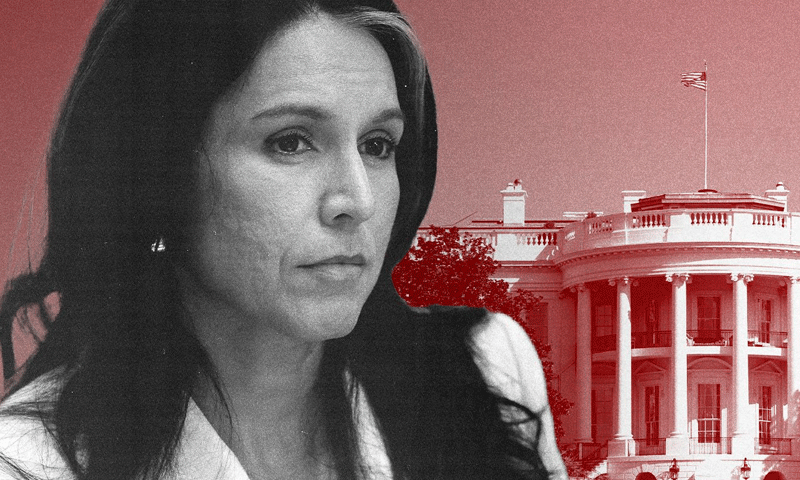
WEB DESK: Tulsi Gabbard, the US Director of National Intelligence, has announced her resignation from the Trump administration, effective from 30 June.
Gabbard, who made history as the first Hindu member of Congress, stated she is stepping down to care for her husband, Abraham Williams, following his recent diagnosis with an “extremely rare form of bone cancer”.
In a resignation letter shared publicly, the 45-year-old Iraq War veteran wrote that she could not “in good conscience” ask her husband to face the illness alone while continuing in her highly demanding, time-consuming position, according to The Washington Post.
President Donald Trump praised her tenure on social media, confirming that Principal Deputy Director Aaron Lukas will step in as acting intelligence chief.
Despite the official focus on family health, Washington insiders suggest Gabbard’s departure follows months of mounting friction inside the White House and sharp internal disagreements over Middle East policy.
A turbulent tenure and ideological shift
Gabbard’s departure concludes a stormy 15-month stint as America’s top intelligence czar. A former progressive darling who ran for the 2020 Democratic presidential nomination, Gabbard underwent a stark political evolution.
After defecting from the Democrats, she rebranded as an independent, actively campaigned for prominent Republicans, and eventually aligned with Trump.
Her nomination to lead the nation’s 18 intelligence agencies surprised many, given her lack of conventional intelligence experience and her strict anti-interventionist foreign policy stance.
Throughout her congressional career and subsequent political rise, Gabbard maintained complex geopolitical ties.
Critics frequently pointed to her early political campaigns, which were heavily bankrolled by executives linked to India’s right-wing Rashtriya Swayamsevak Sangh (RSS) and wider Hindu nationalist networks.
Once in office, Gabbard sought to radically reshape the Office of the Director of National Intelligence (ODNI).
Allies credit her with slashing the agency’s budget by more than $700m annually, dismantling diversity, equity, and inclusion (DEI) programmes, and orchestrating the declassification of over half a million pages of historical government archives, including files related to the JFK assassination.
Policy fractures and White House pressure
Despite the official narrative of a voluntary exit for personal reasons, reports have emerged suggesting that Gabbard was under intense pressure from White House officials to step aside.
Her anti-war stance increasingly clashed with the administration’s aggressive military maneuvers, particularly following President Trump’s decision to launch strikes against Iran.
The policy rift became public during a congressional hearing where Gabbard notably declined to echo Trump’s rhetoric.
In written statements to the Senate Intelligence Committee, she noted that Iran had not attempted to rebuild its nuclear capabilities after previous American strikes a position that directly undercut the President’s public assertions of an “imminent threat”.
Her exit marks the fourth major Cabinet departure from the second Trump administration, closely following the high-profile exits of Attorney General Pam Bondi and Homeland Security Secretary Kristi Noem.
With Gabbard stepping down, Washington analysts expect a consolidation of intelligence influence around CIA Director John Ratcliffe, who has consistently maintained closer ties to the President’s inner circle.