- Monis Siraj
- August 21, 2026
US-Iran ceasefire talks the biggest legacy for future generation in Pakistan: Khawaja Asif
-

- Sadiq Khan
- April 8, 2026
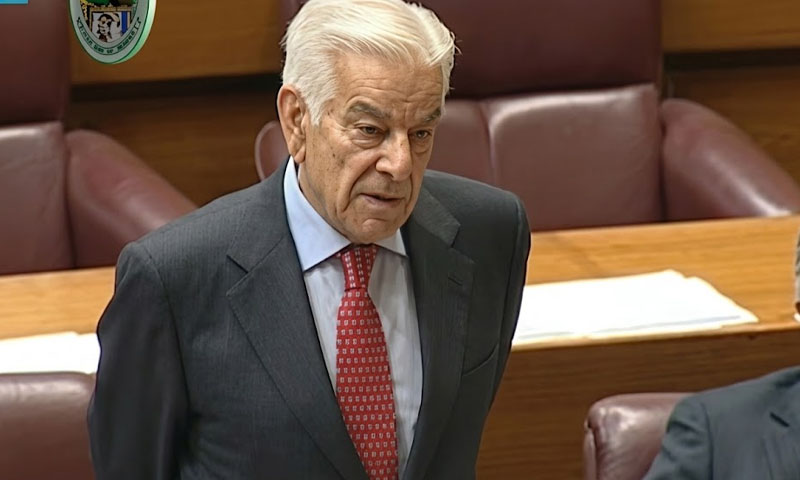
ISLAMABAD: The Federal Defence Minister Khawaja Asif said on Wednesaday that the way Pakistan achieved its success in bringing US and Iran onto the peace-talk table will bear a renewed identity to Pakistan. The US-Iran ceasefire talks, if get through, will be the biggest legacy that “We will ever give to the future generation of Pakistan.”
Meanwhile, Pakistan will host US-Iran talks on Friday in Islamabad, with Mohammad Bagher Ghalibaf, Iran’s parliamentary speaker, and JD Vance, the US vice president, will include the delegations coming from both the archrivals on the table in Pakistan.
The talks, where the Iran’s Ghalibaf and US vice president Vance are coming for, take place in the wake of a two-week ceasefire announced after the US President Donald Trump gave a node. Donald Trump said Washington would halt military action against Tehran following discussions with Prime Minister Shehbaz Sharif and Pakistan’s army chief Syed Asim Munir. The truce, linked to ensuring safe passage through the Strait of Hormuz, has helped ease fears of a wider regional conflict.
Pakistan has emerged as a key diplomatic facilitator, with Islamabad hosting the talks after Iran accepted an offer extended by Prime Minister Shehbaz Sharif during a phone call with Iranian President Masoud Pezeshkian. Both leaders held a detailed conversation lasting over 45 minutes, focusing on the ceasefire, upcoming negotiations and broader regional stability.
During the call, Sharif praised Iran’s leadership for opting for de-escalation and reaffirmed Pakistan’s support for lasting peace, while President Pezeshkian welcomed Islamabad’s role and confirmed Tehran’s participation in the talks.
According to Iran’s state news agency ISNA, Tehran is expected to present a comprehensive 10-point proposal during the negotiations. The plan will address key issues including Iran’s nuclear programme, regional security concerns, and the removal of longstanding US sanctions.
Despite the diplomatic momentum, significant challenges remain. Decades of mistrust continue to overshadow relations, and core disputes, particularly over nuclear ambitions, regional influence, and sanctions relief, are yet to be resolved.
International stakeholders have welcomed the ceasefire and upcoming talks. Countries such as France, Saudi Arabia and China have praised Pakistan’s mediation efforts, while the UN nuclear watchdog, the International Atomic Energy Agency (IAEA), has expressed readiness to support any future agreement through its verification role.
Trump has also suggested that China may have played a role in bringing Iran to the negotiating table, although Beijing has not confirmed specific involvement, reiterating instead its call for dialogue and an end to hostilities.
While the ceasefire has provided temporary relief to global markets and reduced immediate risks to oil supplies, analysts caution that its long-term success will depend on whether the Islamabad talks can translate this fragile truce into a sustainable and comprehensive agreement.
For now, the planned meeting between Ghalibaf and Vance signals a tentative but important shift, from confrontation to negotiation, in one of the world’s most volatile geopolitical standoffs.