- WEB DESK
- October 6, 2026
US urges Asian allies to hike defense spending to 3.5% of GDP, warns of China buildup
-

- Sadia Basharat
- May 30, 2026
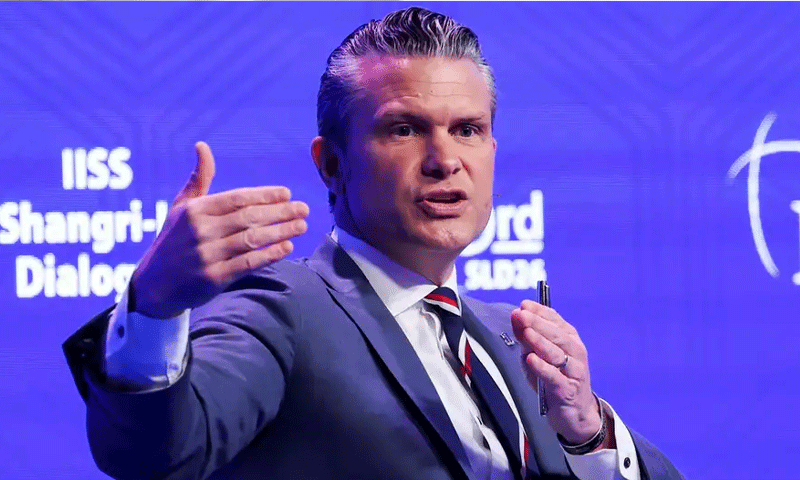
WEB DESK: United States Secretary of Defense Pete Hegseth on Saturday expressed deep concern over China’s rapid military expansion in Asia, while explicitly demanding that Washington’s regional allies and partners escalate their defense expenditures to 3.5pc of their Gross Domestic Product (GDP).
Delivering a keynote address at the high-profile Shangri-La Dialogue in Singapore, the Pentagon chief outlined the Trump administration’s foreign policy framework for Asia, according to DW.
He emphasized that the US is actively pursuing a “stable equilibrium” across the region, asserting that no single nation including China should be permitted to establish uncontested hegemony over the territory.
Favorable balance of power
“What we seek… is a genuinely stable equilibrium that works for Americans as well as our allies a favorable but durable balance of power in which no state, including China, can impose its hegemony and hold the security or prosperity of our nation and our allies in question,” Hegseth told the defense summit.
He remarked that there is a “rightful alarm” spanning the Pacific regarding Beijing’s historic military buildup and the broadening scope of its regional activities.
Despite these sharp warnings, the defense secretary sought to temper anxieties by noting that bilateral communication between Washington and Beijing is “better than they have been in many years,” highlighting a recent uptick in crucial military-to-military interactions.
Observers noted that Taiwan was conspicuously absent from Hegseth’s prepared remarks. When questioned subsequently about a currently paused arms sale to Taipei, the Pentagon chief deflected the matter, stating that the final decision would rest entirely with President Donald Trump.
Partners, not protectorates
Shifting focus to fiscal responsibilities within Washington’s strategic alliances, Hegseth delivered a stern ultimatum to Asian capitals regarding defense self-reliance, signaling an end to American financial cushioning.
“The era of the United States subsidizing the defense of wealthy nations is over… We need partners, not protectorates,” he stated repairingly. “We don’t have a strong alliance unless everyone has skin in the game. No freeloading.”
The rigorous demand mirrors President Trump’s broader foreign policy stance, which has consistently pressured historical allies, particularly North Atlantic Treaty Organization (NATO) member states, to bolster domestic defense funding and reduce dependency on the American military umbrella.
Hegseth also claimed that the US maintains more than sufficient conventional stockpiles and remains fully capable of resuming military operations against Iran if required.
The uncompromising tone triggered immediate unease among local analysts, who observed that the speech’s emphasis on hard deterrence and military expansion over traditional open diplomacy presents an unsettling scenario for Southeast Asian nations seeking to avoid a superpower confrontation.