- WEB DESK
- October 27, 2026
Atta Tarar says govt ‘sacrificed politics to save state’ as opposition lambasts budget
-

- Zafar Ali
- June 14, 2026
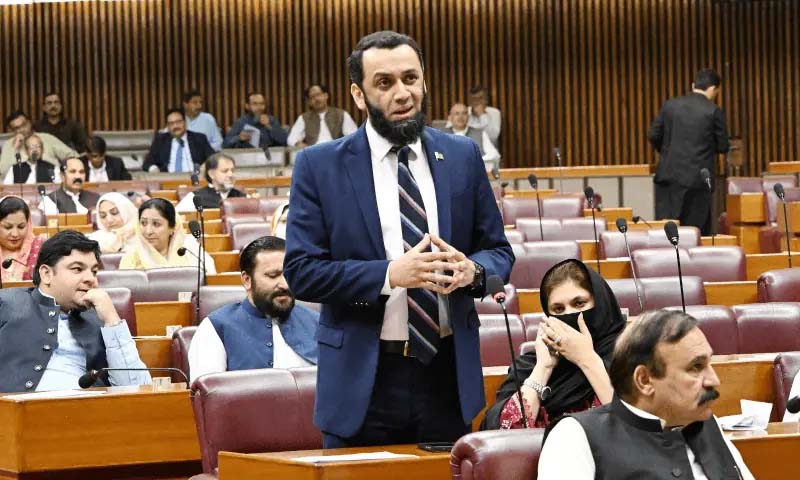
ISLAMABAD: Lawmakers engaged in a fierce war of words in the National Assembly during the federal budget debate as treasury benches defended strict fiscal consolidation while opposition and coalition allies condemned the financial burden placed on citizens.
Speaking in the National Assembly, Information Minister Attaullah Tarar strongly defended the government’s fiscal framework, asserting that the new budget provides substantial relief to the salaried class despite severe economic constraints. arar challenged the opposition to acknowledge the government’s positive measures, noting that individuals earning less than Rs50,000 per month remain completely exempt from income tax, while those earning between Rs50,000 and Rs100,000 face a minimal 1 per cent tax rate.
Key economic indicators cited by Tarar showed foreign exchange reserves at $17.2 billion, enforcement recoveries by the FBR and Finance Ministry at Rs800 billion, and recoveries from the sugar industry at Rs60 billion.
Tarar launched a scathing attack on the opposition, recalling instances of parliamentary disorder where “books were burned and papers thrown from these very desks.”
He credited a critical meeting with the IMF for averting an imminent sovereign default, which he claimed opposition finance ministers actively sabotaged by writing letters to the global lender.
He praised the institutional efforts, specifically highlighting the stabilisation role played by Army Chief General Asim Munir’s team.
Tarar noted that the exchange rate — which previously fluctuated wildly — had stabilised, and interest rates had successfully dropped to 11 per cent from a staggering 22 per cent. He concluded that structural reforms initiated within the Federal Board of Revenue (FBR) would permanently shift the tax tax-burden away from compliant taxpayers onto tax evaders.
The Regulatory Critique
Pakistan People’s Party lawmaker Mirza Ikhtiar Baig leveled sharp criticism against the government’s heavy reliance on indirect taxation, specifically targeting the sharp escalation of the Petroleum Development Levy (PDL).
Baig said that the PDL has ballooned from Rs80 to Rs117 per liter, generating an annual collection of Rs1,745 billion for the national exchequer.
“A common motorcycle or rickshaw driver is being forced to pay Rs117 per liter in petroleum levy. We demand the government immediately slash this levy down to Rs50 or Rs60.”
Baig raised transparency concerns regarding environmental levies, noting that the public is being charged Rs56 billion under a Carbon Support Levy alongside a $1.4 billion climate loan secured from the IMF.
He pointed out that despite a total collection of Rs1,856 billion under various levies, there are no visible projects or line-item details present in the budget document explaining how these funds are being utilised.
MQM’s Resignation Threat
In a stark warning from a key government ally, Muttahida Qaumi Movement-Pakistan lawmaker Syed Waseem Hussain threatened a mass resignation of MQM-P lawmakers if the federal government ignored their budget proposals.
Hussain presented a bleak assessment of Sindh’s urban centres, noting that major cities like Karachi and Nawabshah are plagued by contaminated sewage water and a breakdown of law and order dominated by criminal gangs.
He accused the ruling coalition of monopolising constitutional offices across the country while offering nothing in return to urban Sindh.
Expressing complete alienation, he announced a personal boycott of the fiscal bill, stating, “Whether it makes a difference or not, I will not vote for this budget until there is definitive action to strengthen my province and my city.”
“IMF Compliance Report and Not National Budget’
Speaking in the NA, Jamiat Ulema-e-Islam-F lawmaker Shahida Akhtar Ali questioned the authenticity of the parliamentary oversight process, noting that while 40 hours were officially allocated to debate the financial bill, the house needed to produce at least 40 concrete legislative proposals to justify the session.
Ali criticized the absolute alignment of the state’s economic policy with external diktats, declaring that the federal budget bears closer resemblance to an “IMF compliance report” than an independent national financial policy.
‘An Anti-People, IMF-Authored Blueprint’
Sunni Ittehad Council/ PTI member Malik Amir Dogar condemned the Rs17,000 billion budget as an “anti-people, poor-crushing blueprint” drafted entirely by the IMF.
Dogar pivoted to geopolitics, asserting that if jailed PTI founder Imran Khan were at the helm, foreign powers would not have dared to escalate military tensions in the region against Iran.
He also outlined several budgetary grievances, including insufficient allocations for the Dasu, Mohmand and Bhasha dams, and what he termed a total omission of development projects for Southern Punjab.
Dogar further criticised the imposition of a Rs1,200 billion tax burden through the petroleum levy, and said public relief had been restricted to Rs4 despite a sharp decline in global oil prices.
Dogar warned that political instability and lawlessness are triggering rapid industrial closures, a sharp contrast to the record industrial growth recorded during the PTI administration. He also raised concerns over regional security, stating that rival neighbor India is rapidly constructing dams to store water while Pakistan’s agricultural sector and farmers face total neglect in the current fiscal layout.
‘Youth Valued at Less Than a Samosa’
PPP lawmaker Sharmila Faruqi delivered a data-driven critique of the federal budget, highlighting widening economic inequality.
Faruqi said the salaried class contributed Rs550 billion in taxes but received no relief in return. She added that the government expanded the sales tax net to 21 essential commodities, including milk and sanitary products, instead of broadening the tax base, thereby placing a heavier burden on existing taxpayers.
She also pointed to key economic indicators, noting that the poverty rate stands at 29 per cent, with the government classifying anyone earning above Rs8,483 per month as “not poor.” She warned that no allocations had been made for population control despite a projected population of 390 million by 2050.
Faruqi further highlighted that youth, who make up 68 per cent of the population with around 7 per cent unemployment, had been allocated Rs5 billion in total — equivalent to roughly Rs32 per young person.
She lambasted the Rs5 billion allocation for yout, calculating that the government had valued each young citizen at “less than the price of a single samosa (Rs32),” while simultaneously extending relief to credit card holders, business class travelers, and luxury international shoppers.
‘Budget is a Document of Deception’
Majlis Wahdat-e-Muslimeen leader Allama Raja Nasir expressed absolute mistrust in the government’s economic trajectory, stating that public skepticism regarding the budget is entirely justified. He described the document as a “collection of empty policy claims” stripped of any operational transparency.
Abbas asserted that there is an unbridgeable gulf between real-world public suffering and the idealized targets set by the finance ministry. He proposed that the current financial bill be officially titled “The Deception,” accusing the treasury of using the rhetoric of public relief to camouflage policies that increase economic coercion.
‘A Legacy of Political Victimization Overcome’
Federal Minister for Planning and Development Ahsan Iqbal countered opposition rhetoric by reminding the house of the political environment maintained during the previous PTI administration. Iqbal stated that top Pakistan Muslim League-Nawaz (PML-N) leaders, including Nawaz Sharif and current Prime Minister Shehbaz Sharif, consistently faced fabricated legal charges and imprisonment without abandoning democratic norms.
Iqbal defended the ruling party’s developmental footprint in opposition strongholds, explicitly noting that he had personally laid the foundation stone for Swabi University, delivering a state-of-the-art educational institution to the people of Khyber Pakhtunkhwa despite intense political polarization.
‘Flawed Policies Driving Economic and Regional Ruin’
Sunni Ittehad Council/PTI lawmaker Asad Qaiser closed the opposition’s arguments with a sweeping critique of the government’s domestic and regional policies.
Qaiser challenged the treasury to compare current inflation, electricity pricing and broader macroeconomic indicators with the performance of the Imran Khan-led administration, saying the earlier regime had strengthened the economy through incentives for the construction sector and action against the sugar industry cartel to protect farmers.
He also listed several regional and sectoral concerns, claiming that around 90 multinational companies had exited the country under the current government. He alleged that power-producing Khyber Pakhtunkhwa was facing 12 to 18 hours of daily load-shedding.
Qaiser further accused the authorities of mismanaging the tobacco sector through what he described as illegal deployments of Rangers and the Intelligence Bureau, and said economic activity in Khyber Pakhtunkhwa was being severely constrained due to repeated closures of the Afghan border.
Qaiser strongly questioned the government’s geopolitical logic, asking why trade continues seamlessly with India via the Wagah border while commerce with Afghanistan remains suspended, a policy he claimed is pushing unemployed Pakhtun youth toward extremist elements.
Turning to human rights, Qaiser condemned the systemic political victimization of PTI, noting that Imran Khan is being denied basic medical care and visitation rights mandated by the prison manual. He dismissed the legitimacy of the treasury benches to pass constitutional amendments or fiscal budgets, concluding: “You did not even win in Gilgit-Baltistan; you are a defeated administration, and even your families know you lack the public mandate.”
You May Also Like

- Reuters
- October 27, 2026