Bilawal warns against BISP cuts, says provinces contributing to save economy
-

- Zafar Ali
- June 18, 2026
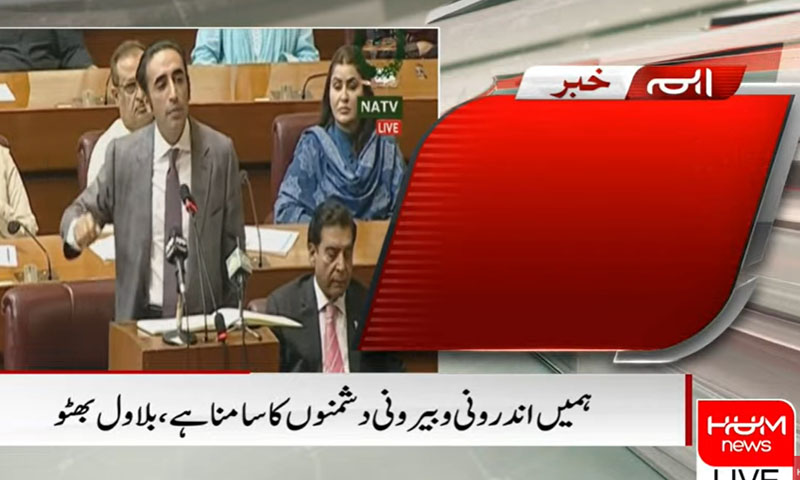

ISLAMABAD: Pakistan People’s Party (PPP) Chairman Bilawal Bhutto Zardari on Thursday issued a stern warning against any attempts to cut funding for the Benazir Income Support Programme (BISP), terming such attempts “regrettable and shameful”.
During his budget speech in the National Assembly, he lauded the federal government for ultimately increasing allocations for the landmark cash-transfer initiative.
Addressing initial media speculation regarding a potential rollback of the 18th Constitutional Amendment or cuts to social safety nets, Bilawal said that a democratic compromise had been struck with Prime Minister Shehbaz Sharif, Deputy Prime Minister Ishaq Dar and Finance Minister Muhammad Aurangzeb.
He said that under the negotiated temporary framework, provincial governments have legally agreed to share the financial burden of national security and defense within the bounds of the constitution.
He underscored that this is a temporary two-to-three-year arrangement, and the federal government has guaranteed that the National Finance Commission (NFC) Award formula will remain fully protected.
He pointed out that provinces have generated large cash surpluses with Punjab’s Rs700 billion surplus last year and Rs900 billion surplus this year to keep the country’s fragile economy afloat.
He noted that while Punjab could have spent those funds locally in underdeveloped regions like Multan and Dera Ghazi Khan, the province consciously held back to prioritise national macroeconomic stability.
He strongly defended BISP, emphasising that global financial institutions recognise it as one of the world’s most successful social welfare projects.
“The solution is to expand this programme, not eliminate it,” he stated, thanking the prime minister for maintaining increases despite broader austerity measures.
He lamented that the state had failed to fulfill its economic promises to the merged tribal districts (formerly FATA). However, he noted that even the Pakistan Tehreek-e-Insaf (PTI) provincial government in Khyber Pakhtunkhwa had appropriately agreed to support the federal government during this financial crunch.
Turning to regional security, Bilawal cautioned that South Asia remains deeply unstable, pointing specifically to threats emanating from New Delhi.
He highlighted aggressive rhetoric surrounding “Operation Sindoor 2.0” — a reference to Indian military warnings following the brief, cross-border standoff and missile engagements of May 2025.
He said that external hostile forces continue to actively sponsor terrorism within Pakistan’s borders.
Conversely, he pointed to a “ray of hope” in broader global diplomacy, citing a recent diplomatic accord between Iran and the United States as concrete proof that “peace is always better than war,” a lesson he remarked that war-weary Pakistan understands all too well.
Pro-Poor Growth Strategy and CPEC
He sharply criticised Pakistan’s persistent reliance on sovereign debt, warning that the country is caught in a precarious trap of taking new loans simply to pay off old ones.
To break this cycle, he urged the administration to design a growth model centered around the common man, rather than affluent landowners or the elite.
“The enrichment of landlords like myself is not the development of Pakistan,” he said. “True progress lies in empowering poor farmers, laborers, and the youth through targeted economic inclusion.”
Reflecting on infrastructure development, the PPP chairman recalled a conversation with a foreign minister who noted that if Pakistan had prioritised the western route of the China-Pakistan Economic Corridor (CPEC) and completed the Gwadar deep-sea port project on schedule, the revenue generated could have funded mass-transit orange trains in every major Pakistani city.
Bilawal voiced strong provincial grievances, noting that the federal government continues to withhold the provinces’ rightful shares of the petroleum levy.
“Originally imposed to combat devastating flood damages, the levy is fully pocketed by the centre, leaving provinces with zero financial space from this pool,” he said.
He warned the house that Pakistan faces a highly volatile external environment, with hostile foreign intelligence agencies aggressively bankrolling domestic terrorism.
“A RAW agent was captured in Balochistan — he certainly wasn’t there on a picnic,” he remarked, pointing directly to Indian state-sponsored subversion.
He cautioned that regional dynamics are shifting rapidly, noting that Israeli Prime Minister Benjamin Netanyahu was a state guest of Indian Prime Minister Narendra Modi just before the outbreak of the Iran-Israel conflict.
Regional Threats and Security
Furthermore, he warned that New Delhi is currently issuing overt military threats under the guise of “Operation Sindoor 2.”
While he vowed that the state would take decisive, unyielding action against anyone taking up arms against Pakistan, he expressed severe concern over recent civil unrest in Azad Jammu and Kashmir (AJK). Delivering a stern message to protesters in AJK, he stated: “Enough is enough. We will not allow anyone to compromise the Kashmiri cause.”
Bilawal hailed a newly minted diplomatic accord between Iran and the United States as a global “ray of hope,” declaring it definitive proof that diplomacy and dialogue are far more potent than conflict.
“Peace is not just a moral obligation; it is a strict economic necessity. When war stops, trade grows and employment flourishes,” he said, adding that war-weary Pakistan knows the true cost of conflict better than anyone.
The PPP chairman delivered a grim assessment of Pakistan’s macroeconomic realities, warning that the country is entirely trapped in a sovereign debt cycle, forced to take out massive new foreign loans just to pay off existing debt liabilities.
He criticised past policy delays, noting that if the China-Pakistan Economic Corridor (CPEC) and the deep-sea Gwadar Port had been completed on their original schedules, the state would have generated enough internal revenues to run orange-line mass transit trains in every single city.
To break the economic stagnation, he urged the Shehbaz Sharif governemnt to pivot toward a pro-poor economic growth model. “The enrichment of wealthy landlords like myself is not the development of Pakistan,” he concluded.
“True progress will only occur when the government designs a concrete plan that delivers economic benefits directly to the common laborer, the impoverished farmer, and the youth.”
Dams and Water Security
Bilawal urged the federal government to step up the construction of strategic water dams and bypass geopolitical vulnerabilities by exploring water imports from Central Asian states.
He said that Pakistan must take swift internal measures to secure its water supply, stressing that Islamabad must strictly block any attempt by India to construct unauthorized dams on Pakistani rivers.
“While India’s conspiracies remain a challenge, we must rapidly accelerate our preparations to build dams,” Bilawal said. “Work must be fast-tracked on consensus-backed water projects across the country, including the Dasu Dam.”
He cautioned that Pakistan cannot afford any diplomatic lapses on trans-boundary water management, firmly stating that Islamabad must not make the mistake of globally accepting unilateral dam construction by New Delhi on shared water channels.
To insulate Pakistan from long-term hydrological vulnerabilities and potential blocks on its western rivers, the PPP chairman proposed an ambitious cross-border pipeline model to diversify the country’s water sources:
Bilawal said that President Asif Ali Zardari had previously designed a strategic blueprint to import water from external nations, mirroring the framework of the transnational Pakistan-Iran gas pipeline.
He proposed drafting an executive plan to safely pipe water directly into Pakistan from Central Asian states, accessing water tables that sit completely outside the strict jurisdiction of the 1960 Indus Waters Treaty.
Under the proposed framework, the imported water would be routed into a comprehensive national logistics network capable of delivering supply to every corner of the country.
Implementing these massive storage and import initiatives, Bilawal said that it is the only definitive way for Pakistan to permanently avert its looming, existential water scarcity threats.