- Usman Khan
- November 10, 2026
Dar warns military force narrowing space for diplomacy amid global tensions
-

- WEB DESK
- November 10, 2026
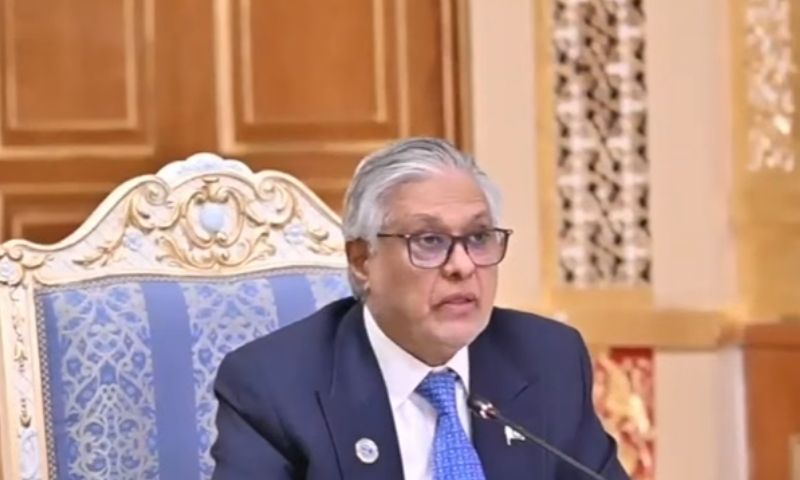
Deputy Prime Minister and Foreign Minister Ishaq Dar has defended the Makkah Joint Defence Agreement (MJDA), saying the arrangement reflects Pakistan’s partnerships and is not directed against any country, as he called for dialogue and diplomacy to address growing regional and global tensions.
Addressing the Margalla Dialogue in Islamabad on Tuesday, Dar said intensifying competition among major powers was increasing the risk of confrontation and miscalculation, while the growing use of military force was narrowing the space for diplomatic engagement. Signed by Pakistan, Saudi Arabia and Turkiye in August, MJDA stipulates that an attack on any one of the three signatories will be treated as an attack on all.
“The Makkah Joint Defence Agreement is a symbol of our partnership,” Dar said, adding that the agreement was not directed against any country.
He said Pakistan sought a peaceful, stable and economically integrated environment and believed no country’s territory should be used for terrorist activities against another state.
“Pakistan is committed to the peaceful resolution of conflicts,” Dar said, stressing that disputes must be settled through negotiations to achieve shared prosperity.
“The international security infrastructure is under severe pressure,” he said, calling multilateral diplomacy an urgent necessity and emphasising the importance of cooperation in addressing common challenges.
Pakistan’s diplomatic and strategic partnerships
Dar said Pakistan attached importance to its relations with friendly countries and international partners, identifying China, the United States, Saudi Arabia, Turkiye, Japan, Egypt, the United Arab Emirates and Malaysia as important partners.
He described the strategic partnership with China as a fundamental pillar of Pakistan’s foreign policy, adding that Islamabad wanted to strengthen national security while maintaining diplomatic engagement and opportunities for development.
The foreign minister said enhancing defence and technological capabilities, alongside creating an enabling environment for economic growth, remained among Pakistan’s priorities.
He added that the government was pursuing measures to promote business activity, generate employment opportunities and improve people’s living standards.
Dar also stressed the importance of strong institutions, a skilled workforce and a business-friendly environment to attract investment.
Global rivalries and pressure on multilateral institutions
Dar said growing geopolitical rivalries were intensifying competition over trade, technology, energy and investment, making domestic strength and effective diplomacy increasingly important for national security and public prosperity.
He warned that the selective application of international laws and the inconsistent implementation of international principles were creating discrimination and undermining confidence in the global system.
“The selective application of international laws gives rise to discrimination,” he said, calling for a more effective role for international institutions, particularly the United Nations, in addressing emerging challenges.
The deputy prime minister said the international order was undergoing significant changes, with political differences among countries making it increasingly difficult for multilateral institutions to respond effectively.
He also noted that geopolitics, economic affairs and financial matters were becoming increasingly interconnected, requiring countries to strengthen cooperation to deal with shared challenges.
Highlighting the opportunities offered by emerging technologies, Dar said technological advancements were creating new possibilities, while climate change remained a major challenge requiring coordinated strategies and collective action.
He said sustainable development was not possible without regional peace and stability, reaffirming Pakistan’s commitment to promoting trade and connectivity across the region.
Dar added that economic stability and sovereignty remained fundamental priorities of Pakistan’s foreign policy, while Islamabad believed in constructive engagement with all regional and international partners.
Pakistan’s mediation between US and Iran
Since the US-Israel war with Iran began on February 28, Pakistan has emerged as one of the most active intermediaries between Washington and Tehran, using its ties with both sides to keep diplomatic channels open.
Islamabad’s role became more visible in early April, when Pakistan helped put forward a two-stage Islamabad Accord proposal calling first for an immediate ceasefire and then wider negotiations on Iran’s nuclear programme, sanctions and the Strait of Hormuz.
Prime Minister Shehbaz Sharif later said talks hosted in Islamabad included a 21-hour negotiating session involving the two sides.
Those efforts eventually produced the Islamabad Memorandum of Understanding in June, signed by US President Donald Trump and Iranian President Masoud Pezeshkian, with Pakistan acting as mediator.
The arrangement, however, began to fray within weeks as fighting resumed and both sides accused each other of violations.
Pakistan has since continued shuttle diplomacy through Prime Minister Shehbaz, Ishaq Dar, Interior Minister Mohsin Naqvi and Field Marshal Asim Munir. Their repeated diplomatic engagements, including visits to Tehran, have focused on reviving stalled negotiations, reopening the Strait of Hormuz and preventing further regional escalation.
Dar described the Margalla Dialogue as an important platform for examining regional and global challenges, stressing that intellectual exchange and serious debate were necessary to develop responses to evolving international issues.
“Collective efforts are indispensable for achieving peace, security and sustainable development across the world,” he said.
You May Also Like
- Reuters
- November 10, 2026