- Reuters
- November 13, 2026
Is Vance reconsidering 2028 White House bid after Republican midterm setback?
-

- WEB DESK
- November 13, 2026
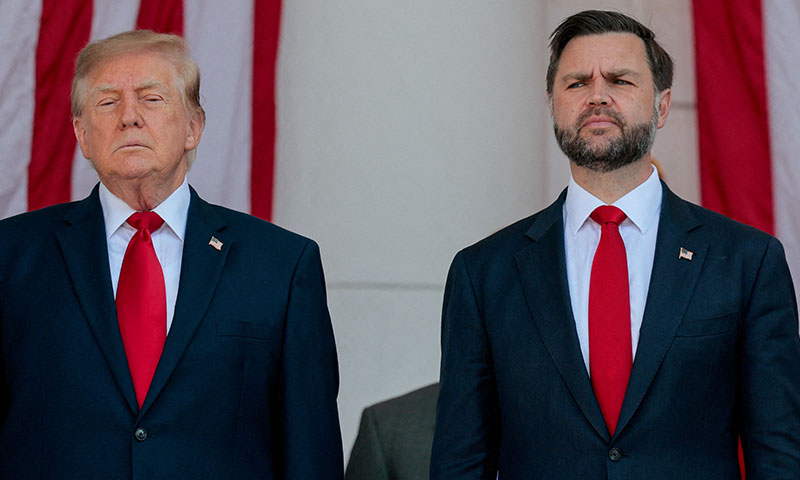
US Vice President JD Vance is seriously considering not running for president in 2028 following the Republican Party’s disappointing performance in last week’s midterm elections, CNN reported on Friday.
Interviews with around a dozen of Vance’s allies and advisers suggest he is weighing his political ambitions against divisions within the Make America Great Again (Maga) movement and the demands of fatherhood.
Although he has yet to make up his mind, the 42-year-old vice president is reportedly uncertain whether he should lead the movement that helped Donald Trump win the 2024 presidential election.
“I wouldn’t be surprised by any decision he makes,” one person close to Vance told CNN, adding that he was young enough to make a political comeback later. “It just may not be his time.”
Some of his supporters, however, remain convinced that he will enter the 2028 race.
Terry Schilling, president of the American Principles Project, a conservative advocacy group, said it would be a mistake for Vance to abandon his presidential ambitions because of the current political climate.
“He’s basically teed up to be the general and we’re going into one of the biggest battles,” Schilling said. “I would be surprised if he doesn’t run.”
Iran war clouds Vance’s presidential ambitions
A major factor in Vance’s calculations is the US war on Iran, which has become an increasingly unpopular issue for the Trump administration.
The conflict began with US and Israeli strikes against Iran in February, triggering Iranian retaliation and escalating tensions across the Middle East. Despite Trump’s initial expectations of a short military campaign, the fighting extended into its eighth month, adding to economic pressures, including higher energy costs.
Vance openly linked the Republican Party’s midterm losses to the conflict in a lengthy post on X the morning after the November 3 elections.
“The reason we lost is the war. The president himself said so last night,” he wrote, questioning whether the political cost of losing the Senate for the next six years had been worth the military campaign.
One of the things the data analysts on our side obsessed over was “composition”—whether the electorate looked close enough to 2024 for Republicans to win. And despite polls that showed a Democrat blowout, the data kept on telling us the same story: in some states turnout was merely OK, in other states it was downright amazing, and in no state was it catastrophic. There was a genuine sense of optimism on our team: our people were showing up.
So, I asked the smartest data guy I know, does that mean we’re going to shock the world? “No,” he told me. “We might do better than the polls suggest. But the data is telling us that a lot of Trump/Vance 2024 voters are pissed and planning to vote for the other guys. Our voters are turning out, but they may not vote for us.”
Well, that looks prophetic now. Our voters did show up. In Florida, for example, the electorate was 9 points more Republican than Democrat, just a couple points worse than 2024. Undoubtedly there were places we could have done better on turnout. But the main problem is not turnout. The main problem is that many people who voted for Trump/Vance in 2024 voted for Democrats in 2026.
There will be a lot of infighting and arguing over what happened and why that is. One of the pollsters I really respect told me that our economic messaging wasn’t sharp enough down the stretch. I’m sure that’s true.
But the real reason we lost is obvious to almost everyone.
Another pollster—one of the smartest people I know in politics, told me yesterday we’d lose the generic ballot by 13 points. I felt negative going into Tuesday, but even I was shocked by this. In his polling, he saw that a lot of Trump 2024 voters were angry and planning to vote for Democrats. He asked those voters who had abandoned us what would cause them to come back on our team. The top four answers, accounting for nearly all of the responses were:
1) End the war
2) Focus on cost of living/inflation
3) Put America First
4) Change our relationship to IsraelOur voters showed up. And the above four reasons are why many of them voted for Democrats. This is according to a pollster who nailed the results. While many spent Monday attacking Rachel Campos Duffy for calling for a diplomatic resolution to the conflict, it turns out her political advice was sound. (She’s also a great person.)
In the next few months, there’s going to be a lot of gaslighting. Expect to hear any number of establishment politicians say the solution to our woes is amnesty. I’m open to the idea that we should change enforcement—by focusing more on businesses that hire illegal labor, for instance. But anyone pushing amnesty is lying to you.
The reason we lost is the war. The president himself said so last night.
If you’d like to argue it was worth it, that losing the Senate for the next 6 years was worth it, then do so. Argue it was a worthwhile cost to pay. Agree or disagree, that’s at least honest.
But everyone knows why we lost. And any honest conversation about where we go from here must start there.
I remain hopeful about our country. To the people who are pissed off and want to say, “I told you so”: you’re right, you did tell us so. Take that energy into electing Republicans who share your worldview. To the people who are just pissed at the results, you should be. Let’s take that anger and get back to the work of saving our country.
— JD Vance (@JDVance) November 4, 2026
His remarks reflected reservations he had reportedly expressed to Trump even before the strikes began. Some administration officials interpreted the post as an attempt by the vice president to distance himself from the unpopular conflict and protect his political future.
A Vance ally told CNN that the war could determine the Republican Party’s prospects in the next presidential election.
“The question isn’t if JD can do it. It’s: If the Iran war is still happening, can any Republican do it?” the ally said. “If they don’t end the war in Iran, no Republican has a shot at 2028.”
Trump reacts to Vance’s remarks
Trump publicly played down the vice president’s criticism but made clear that he expected him to defend the decision to launch the military campaign.
“He was right, other than one thing,” Trump told reporters on Sunday. “He should have made one other statement: ‘If you had to do it again, would you do it again?’ The answer is yes.”
According to CNN, Trump was privately unhappy with how Vance had handled his criticism, despite being briefed about the post beforehand.
The president subsequently directed Vance to step back from Iran negotiations and focus instead on what Trump described as corruption and crime in Democratic-controlled cities and states.
“We don’t need a deal with Iran. Those days have long since passed,” Trump wrote on Truth Social on Thursday.
However, on November 4, a day after the midterm elections, Trump also expressed uncertainty about Vance’s plans for the 2028 presidential race.
Asked whether he knew who would run for president in 2028, Trump said he did not know, adding: “Maybe he won’t run. I don’t know who’s going to run.”
US President Donald Trump says Vice President JD Vance may not run for president in 2028, adding that he does not know who will enter the race. https://t.co/mnR4EcYKME
— Al Arabiya English (@AlArabiya_Eng) November 5, 2026
The president also said he understood Vance’s position on the Iran war, describing his post blaming the conflict for the Republican losses as “fine” and “good”.
The remarks added to questions about the political relationship between the president and his potential successor.
Trump yet to commit to Vance endorsement
Although Vance was selected as Trump’s running mate in 2024 partly to succeed him politically, the president has not committed to endorsing his vice president if he seeks the White House in 2028.
Vance has said he expects Trump’s backing should he decide to run. However, Trump has told aides and allies that he wants to see how other potential candidates perform before endorsing anyone.
Trump reiterated his reluctance to commit to backing a candidate in an interview with CBS’s “60 Minutes”, which aired on November 8.
Asked whether he would eventually endorse a candidate in the 2028 Republican presidential primary, Trump replied: “Probably — not necessarily.”
🚨 NOW: President Trump floats MARCO RUBIO as another 2028 presidential candidate option on top of JD Vance
CBS: I assume you’re going to endorse someone for that.
TRUMP: Probably, not necessarily.
CBS: Who’s on the list besides the VP?
TRUMP: I think Marco’s great. There’s many others, and I’d rather not mention their names. Some senators are excellent.
CBS: Do you think you can have MAGA without you as the leader?
TRUMP: I think so. Because MAGA is basically common sense. Strong borders, good military. We have created wealth at a level that our country has never seen before.
Republicans have a great bench for 2028, and the main criteria is putting AMERICANS FIRST 🇺🇸
We will need a big election win to re-take the Senate, needing to win every battleground and probably New Hampshire.
It’s gonna be tough, but it’s the only way to cancel out Democrat gains!
— Eric Daugherty (@EricLDaugh) November 9, 2026
“We have a tremendous bench. I have so many people that I have great relationships with,” he said, adding that he might not get involved in the contest.
“So I may or may not get involved. I don’t know. Maybe I’m better off not getting involved,” Trump added.
Meanwhile, other Republicans, including Florida Governor Ron DeSantis, Texas Senator Ted Cruz and Georgia Governor Brian Kemp, have begun positioning themselves for the 2028 contest.
Schilling acknowledged that the midterm results had changed the political landscape, saying: “I do think the field has been blown open, and there isn’t an heir apparent.”
Vance has not set a timeline for his decision, and a presidential bid remains on the table.
You May Also Like
- WEB DESK
- November 13, 2026