
- WEB DESK
- November 13, 2026
One year, 9,000 cases: What has FCC delivered?
-

- WEB DESK
- November 13, 2026
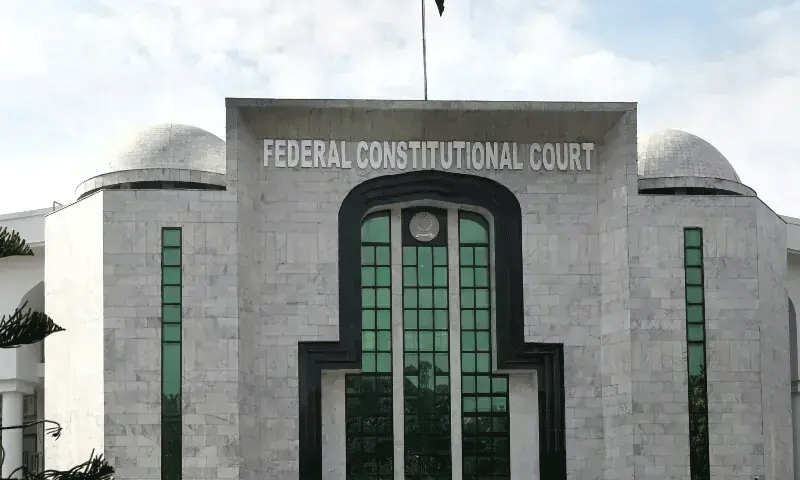
ISLAMABAD: From defining its authority over the Supreme Court and upholding the super tax to striking down property taxation and restraining the Peshawar High Court proceedings, the FCC has delivered rulings with far-reaching implications for the country’s judicial, fiscal and constitutional landscape.
The Federal Constitutional Court (FCC) has disposed of around 9,000 cases in its first year, Chief Justice Aminuddin Khan announced on Friday as the newly established court marked its first anniversary.
The court formally began functioning on November 13, 2025, following its establishment under the 27th Constitutional Amendment, which transferred constitutional jurisdiction previously exercised by the Supreme Court to the new judicial institution.
Addressing an anniversary ceremony in Islamabad, the chief justice described the disposal of 9,000 cases in a year as a record in Pakistan’s judicial history. He said the court had delivered decisions swiftly while ensuring that all parties were given an opportunity to present their arguments.
Beyond the number of cases decided, however, the FCC’s first year has been marked by a series of significant judgments touching on the balance of power within the judiciary, the government’s taxation authority, property rights, civil servants’ entitlements and the constitutional jurisdiction of high courts.
Some of the decisions have also brought the relationship between the FCC and the Supreme Court into sharper focus, raising important questions about judicial hierarchy and the interpretation of constitutional provisions.
The following are 10 significant rulings delivered by the court during its first year.
Judicial hierarchy
In a significant ruling defining its constitutional position, the FCC held that its judgments deciding questions of law or laying down legal principles are binding on all courts in Pakistan, including the Supreme Court.
The judgment, authored by Justice Aamer Farooq, interpreted Article 189(1) of the Constitution, as amended by the 27th Constitutional Amendment.
The court observed that the binding effect of its decisions was not restricted to the ratio decidendi, or the legal reasoning essential to a judgment, but also extended to observations that determine a question of law or enunciate a legal principle.
The ruling came in a matter concerning permanent appointments in the Islamabad Capital Territory Private Educational Institutions Regulatory Authority (ICT-PEIRA).
The decision assumed particular significance amid uncertainty over the relationship between the country’s two apex courts following the creation of the FCC.
Judicial independence
In another important ruling, the FCC clarified that judgments of the Supreme Court were not binding on it, although they could be considered persuasive when consistent with the law and Constitution.
An eight-page judgment authored by Justice Aamer Farooq stated that the FCC could draw guidance from the Supreme Court’s jurisprudence but was not constitutionally bound to follow it.
The court also clarified that the Supreme Court’s established jurisprudence concerning leave to appeal against High Court decisions under Article 199 was not binding on the FCC.
The ruling came while dismissing a review petition filed by Balochistan Trading Company against an earlier FCC judgment concerning a decision of the Balochistan High Court.
Together with the FCC’s pronouncement on Article 189, the judgment helped define the new judicial hierarchy, asserting the constitutional authority of the FCC while establishing that it would independently interpret constitutional questions rather than remain bound by previous Supreme Court precedents.
Institutional propriety
The FCC expressed serious reservations over a subsequent Supreme Court bench taking up a matter that had already been decided, highlighting the importance of judicial discipline and institutional propriety.
The controversy concerned the Income Support Levy Act, 2013, and a Supreme Court judgment delivered on December 28, 2021, which had held that the legislation was constitutionally invalid because it had been enacted through the Finance Act, 2013, without following the prescribed legislative procedure.
While deciding review petitions against the earlier judgment, a two-member FCC bench headed by Chief Justice Aminuddin Khan criticised the subsequent proceedings before the Supreme Court.
The FCC expressed concern that a later Supreme Court bench had granted leave to appeal on substantially identical questions and contemplated reconsidering an issue already determined by the court.
In its October 28 decision, the FCC dismissed 1,178 review petitions and upheld the earlier judgment.
The chief justice observed that the course adopted by the subsequent Supreme Court bench raised serious concerns regarding judicial discipline, legal norms and institutional propriety.
The ruling reinforced the principle that courts must respect previously settled questions and follow established procedures before reopening matters already determined by judicial forums.
FCC upholds super tax
In a major ruling with significant implications for government revenue, the FCC upheld the constitutional validity of the super tax imposed under Sections 4B and 4C of the Income Tax Ordinance, 2001.
On January 27, 2026, a three-member bench upheld the levy, providing legal backing to a tax that has been a major source of revenue for the government. The ruling was estimated to secure around Rs310 billion in public revenue.
Corporate entities and other taxpayers subsequently challenged the decision through review petitions.
On November 11, the court dismissed more than 395 such petitions, leaving its original judgment intact.
Chief Justice Aminuddin Khan, who headed the three-member bench, held that review jurisdiction could not be used as a substitute for an appeal or as a means of reopening controversies that had already been conclusively decided.
The court maintained that review was warranted only to correct a manifest error, patent illegality or another recognised legal infirmity.
The decision was significant not only for the government’s revenue position but also for defining the limits of judicial review in taxation disputes.
Property taxation
In a major setback to the Federal Board of Revenue (FBR), the FCC struck down Section 7E of the Income Tax Ordinance, 2001, which allowed the government to tax deemed income from certain immovable properties even when they were not generating actual income.
The provision had been introduced through the Finance Act, 2022, for tax year 2023 as part of the government’s efforts to broaden the tax base and bring underutilised assets into the tax net.
In a judgment announced on May 7, 2026, the FCC declared the provision unconstitutional.
The case, Sher Muhammad Mughari v Federation of Pakistan, was heard by a two-member bench headed by Chief Justice Aminuddin Khan and comprising Justice Ali Baqar Najafi.
The court allowed taxpayers’ appeals against judgments of the Lahore and Sindh high courts while dismissing the FBR’s petitions challenging decisions of the Peshawar High Court and Balochistan High Court.
The FCC subsequently explained that the levy was confiscatory in nature because it could force owners of non-income-generating properties to dispose of their assets to meet tax liabilities.
The ruling had important implications for the government’s property taxation regime and the limits of its authority to impose taxes on notional rather than actual income.
FCC allows FBR to conduct tax raids without prior notice
The FCC also delivered an important ruling concerning the enforcement powers of tax authorities, holding that the FBR could conduct searches and inspections of taxpayers’ premises without prior notice or pending proceedings.
The judgment came in a petition filed by M/s Sceptre Pvt Ltd, which had challenged a tax raid conducted under Section 175 of the Income Tax Ordinance, 2001.
A three-member bench headed by Justice Aamer Farooq dismissed the petition in February 2026, upholding the tax authorities’ power to inspect premises, records and digital data for enforcement purposes.
The petitioner had argued that such powers should be exercised only when formal proceedings were pending and that a notice under Section 176 could not provide the basis for a search.
The court rejected that interpretation, observing that Section 175 empowered tax authorities to act for the enforcement of provisions of the Income Tax Ordinance.
The judgment interpreted the statutory language as allowing authorised officers to conduct searches and inspections without first initiating formal proceedings.
The ruling strengthened the FBR’s enforcement powers, while raising important questions about the scope of tax authorities’ access to private premises and business records.
Property rights
In a significant ruling on constitutional property rights, the FCC held that land acquired by the state for a specific public purpose could not subsequently be diverted into private housing schemes or commercial projects at the discretion of the acquiring authority or its successor.
The judgment, authored by Chief Justice Aminuddin Khan, upheld a Peshawar High Court decision refusing to allow provincial authorities to change the designated use of acquired land.
The court invoked the constitutional protection of property under Article 24, explaining that the state’s power of compulsory acquisition, known as eminent domain, could only be justified by a genuine public purpose.
It observed that when the state acquired private property for a specified public project, such as a hospital, the land could not ordinarily be transferred or leased for private or commercial use.
The court described such a diversion as indirect expropriation in favour of private interests.
It further held that if the stated public purpose was fictitious, abandoned or materially altered, the constitutional justification for acquiring the property could no longer be sustained.
The ruling reinforced safeguards against the misuse of compulsory land acquisition powers and protected private owners against the diversion of their acquired land for purposes unrelated to the original public interest.
Constitutional jurisdiction
One of the most consequential and controversial decisions of the FCC’s first year came in November 2026, when it ordered the suspension of proceedings under Article 199 of the Constitution in the Peshawar High Court for petitions filed on or after October 12.
The decision followed the imposition of emergency and governor’s rule in Khyber Pakhtunkhwa and the deployment of armed forces in aid of civil power under Article 245.
A two-member FCC bench comprising Chief Justice Aminuddin Khan and Justice Aamer Farooq passed the order on November 5 while hearing appeals filed by the Khyber Pakhtunkhwa government against Peshawar High Court orders concerning the detention and release of political workers under Section 3 of the Maintenance of Public Order (MPO) Ordinance.
The provincial government had challenged the High Court’s intervention in matters involving preventive detention.
The FCC held that since armed forces had been called in aid of civil power throughout the province under Article 245, proceedings instituted under Article 199 on or after October 12 would remain suspended under Article 245(4).
The court also directed the KP advocate general to submit a report identifying areas where the presence of armed forces was no longer required to assist the civil administration.
It said the suspension could be reconsidered after examining the report.
The decision had immediate consequences for access to constitutional remedies in the province. On November 7, the Peshawar High Court’s administrative committee directed that petitions filed on or after October 12 would not be fixed for hearing and that fresh petitions would not be entertained.
The ruling raised significant questions about the extent to which constitutional jurisdiction can be restricted during the deployment of armed forces in aid of civil power.
Civil service rights
In a significant ruling affecting bereaved families of government employees, the FCC protected employment rights that had accrued under Rule 17-A and the Prime Minister’s Assistance Package before the relevant policies were withdrawn or declared unconstitutional.
The case arose after the Supreme Court, in its October 2024 judgment in the General Post Office case, declared certain employment arrangements for family members of deceased civil servants unconstitutional.
The ruling created uncertainty over whether families whose entitlement had arisen before the judgment could still claim appointments.
In February 2026, the FCC addressed the issue in Province of Sindh v Muhammad Rizwan and others, involving a series of appeals concerning the employment rights of family members of deceased government employees.
The court held that the relevant right accrued when the civil servant died in service, rather than when the family member was eventually appointed.
It further clarified that the Supreme Court’s judgment would operate prospectively and could not retrospectively extinguish rights that had already accrued to families.
The FCC dismissed the appeals and upheld the interpretation that families whose entitlement had arisen before the Supreme Court’s ruling could still be considered under the applicable assistance package.
The decision was important for families whose applications had been delayed or rejected following the withdrawal of the employment policy.
It also established an important legal principle concerning the retrospective application of judicial decisions and the protection of vested rights.
Transparency and merit
In another important service-related judgment, the FCC directed government departments and autonomous bodies to prepare, maintain and publish updated seniority lists of their employees.
The ruling came in Capt Muhammad Ali Khan v Port Qasim Authority, decided on May 21, 2026.
A two-member bench comprising Justice Syed Hasan Azhar Rizvi and Justice Muhammad Karim Khan Agha held that maintaining and disclosing seniority lists was a legal obligation rather than an administrative discretion.
The court directed appointing authorities in government departments, statutory bodies and government-owned or controlled organisations to prepare and circulate seniority lists after every fresh recruitment, promotion, regularisation or other change affecting an employee’s seniority.
It further ordered that the lists be reviewed and updated every January and uploaded to the respective departments’ official websites.
The judgment also addressed the determination of seniority among employees recruited in the same batch.
The court held that seniority should be determined according to the merit position assigned by the departmental selection committee rather than simply the date on which an employee joined service.
It linked access to service records with the fundamental right to information guaranteed under Article 19A of the Constitution.
The court directed that copies of the judgment be sent to provincial chief secretaries and the Establishment Division to ensure implementation across government departments.
The decision was aimed at improving transparency, preventing arbitrary administrative decisions and reducing disputes over promotions and seniority.
A first year marked by judicial restructuring and consequential rulings
The FCC’s first year has seen it established its position within Pakistan’s restructured judicial system while deciding cases with implications extending well beyond individual litigants.
Its judgments have addressed the constitutional relationship between the two apex courts, upheld major taxation measures, struck down a controversial property tax provision, strengthened the enforcement powers of tax authorities and placed restrictions on the use of compulsory acquisition powers.
The court has also intervened in matters involving the constitutional jurisdiction of the Peshawar High Court during the deployment of armed forces in Khyber Pakhtunkhwa, while clarifying the rights of government employees and their families.
The 9,000 cases disposed of during the year, as announced by the chief justice, represent the court’s overall reported workload. The 10 judgments highlighted, however, illustrate the breadth of its emerging jurisprudence and the institutional influence it has sought to establish.
The central question going into the FCC’s second year will be how its expanding constitutional authority, particularly in relation to the Supreme Court and high courts, shapes the country’s judicial system and the protection of citizens’ fundamental rights.
You May Also Like


- WEB DESK
- November 13, 2026
PM vows to end raw mineral exports, boost domestic processing

- Farah Mehjabeen
- November 13, 2026
