
- Monis Siraj
- August 21, 2026
Solar grid in times of Iran war: strategic asset in Europe, financial fault line in Pakistan
-

- web_desk
- April 23, 2026
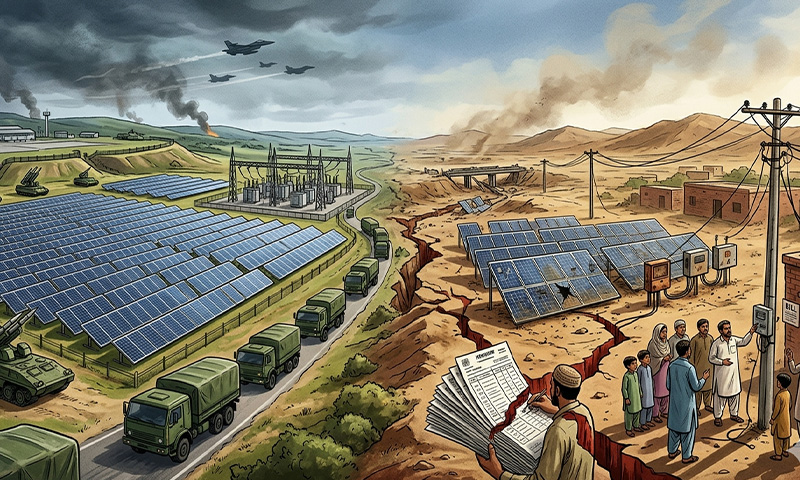
A quiet contradiction is emerging at the heart of Pakistan’s power sector.
Even as households are being nudged away from generating their own electricity through recent changes to net metering, distribution companies (DISCOs) have been found procuring power outside the national grid, often at higher costs, in apparent violation of the economic merit order.
At first glance, these developments seem unrelated. One concerns rooftop solar policy; the other, internal inefficiencies in power procurement. But taken together, they point to a deeper structural shift: Pakistan is not resisting decentralisation – it is fragmenting it!
A SYSTEM BYPASSING ITSELF
The government’s decision to probe DISCOs for purchasing expensive electricity from small power producers (SPPs) and captive power plants (CPPs) through bilateral contracts is significant not just for what it reveals, but for what it implies.
These purchases, reportedly made outside the framework of the Independent System and Market Operator (ISMO), bypass the economic merit order; the principle that electricity should be dispatched from the cheapest available source first. In doing so, they risk raising overall system costs, which are ultimately passed on to consumers through higher tariffs.
More importantly, they suggest that parts of the system are already operating outside the centralised grid architecture. Faced with supply constraints, inefficiencies, or reliability concerns, DISCOs appear to be informally securing power wherever they can, even if it comes at a premium.
This is, in effect, a form of decentralisation. But it is one that is opaque, uncoordinated, and economically inefficient.
CONSUMERS FOLLOWING SUIT
At the same time, Pakistani households have been making their own move away from the grid.
Over the past few years, rising tariffs and unreliable supply have driven a surge in rooftop solar installations. Net metering made this shift financially viable by allowing consumers to export excess electricity back to the grid at near-parity rates.
That equation has now changed.
Under the revised framework, export tariffs have been sharply reduced while import tariffs remain high, effectively turning net metering into net billing. The financial incentive has shifted decisively: solar users are now encouraged to consume their own generation rather than sell it.
The result is a slowdown in the very decentralised, consumer-led energy transition that had begun to take shape.
A TALE OF TWO RESPONSES
Globally, similar pressures are producing very different outcomes.
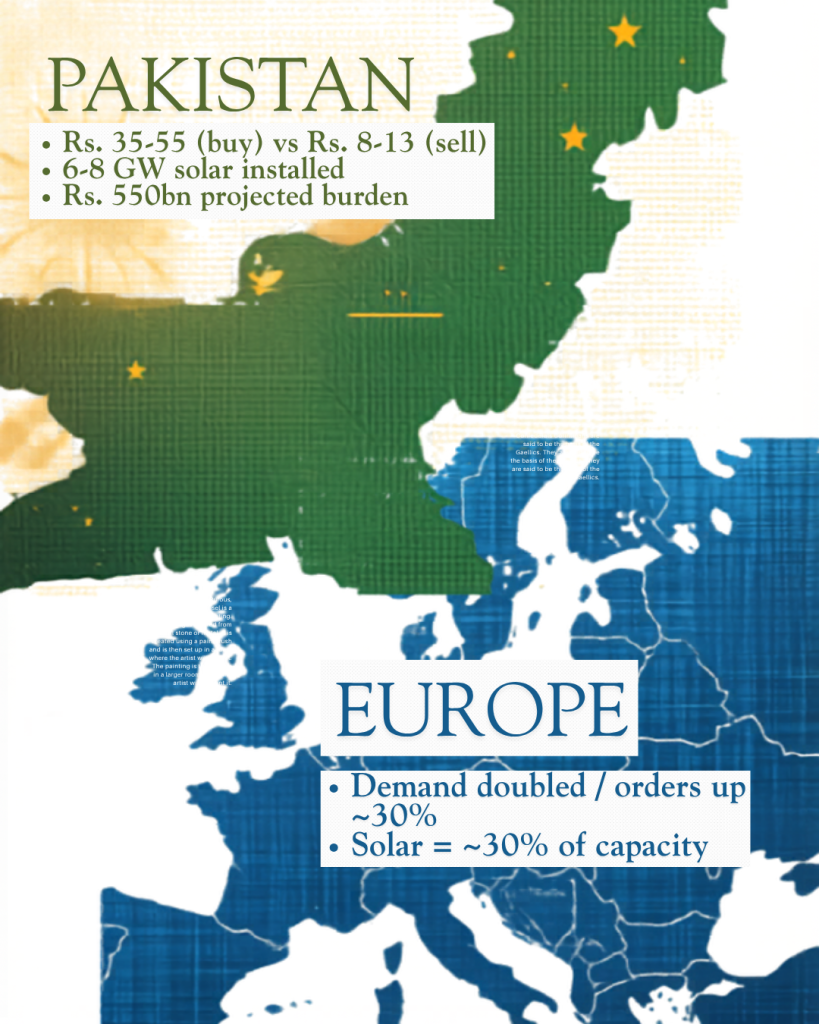
In Europe, a surge in energy prices following the Iran war has triggered a sharp rise in demand for rooftop solar systems. Households are increasingly investing in full setups that include batteries and storage, allowing them to reduce reliance on volatile grid supply and shield themselves from price shocks.
This is decentralisation as a policy-aligned response: consumers react to high prices by generating their own power, and the system evolves to integrate that behaviour.
Pakistan, by contrast, presents a more conflicted picture.
High tariffs and supply instability have created the same incentives for consumers to go solar. But policy adjustments are dampening that response, even as utilities themselves appear to be stepping outside the grid in search of supply.
The divergence is striking: while households are being pulled back towards the grid, parts of the grid are quietly stepping away from it.
WHO GETS TO DECENTRALISE?
This raises a critical question: who is allowed to exit the grid, and on what terms?
In Pakistan’s current trajectory, decentralisation is occurring asymmetrically. At the top of the system, DISCOs are engaging in off-grid procurement, effectively creating a parallel market for electricity. At the bottom, consumers face reduced incentives to generate and export their own power.
The consequence is neither a fully centralised system nor a competitive decentralised one. Instead, it is a fragmented structure in which inefficiencies at the utility level coexist with constraints on consumer-level innovation.
THE COST OF MISALIGNMENT
This misalignment has direct economic implications.
In theory, decentralisation (whether through distributed generation or competitive procurement) should lower costs by introducing flexibility and competition. But when it occurs without transparency or coordination, it can have the opposite effect.
Off-merit power purchases by DISCOs increase the average cost of electricity. At the same time, discouraging rooftop solar reduces the potential for consumers to offset demand and ease pressure on the grid.
Rather than correcting price signals, the system risks amplifying them.
The result is a cycle in which high costs drive alternative behaviour, but policy and practice prevent those alternatives from delivering system-wide relief.
AN INFLECTION POINT
Pakistan’s power sector now appears to be at an inflection point.
One path leads towards a more integrated model of decentralisation, where distributed generation, storage, and flexible procurement are brought into a coherent framework governed by transparent pricing and regulation.
The other leads towards deeper fragmentation, where different parts of the system operate under conflicting incentives, driving up costs and undermining efficiency.
The recent probe into DISCO practices, alongside the recalibration of net metering, suggests that policymakers are aware of the pressures building within the system. The challenge lies in aligning responses across all levels, from utility procurement to household generation.
THE BROADER LESSON
If there is a lesson from global trends, it is that energy systems are increasingly shaped by how they respond to shocks.
In Europe, geopolitical disruption has accelerated a shift towards self-generation and resilience at the household level. In Pakistan, similar pressures are exposing cracks within the grid itself.
Whether those cracks evolve into a more flexible, decentralised system, or widen into structural inefficiencies, will depend on how coherently policy aligns with the behaviour already underway.
For now, the paradox remains: in a moment when both utilities and consumers are seeking ways around the grid, Pakistan’s energy transition is pulling in two different directions.